> ## Documentation Index
> Fetch the complete documentation index at: https://docs.mythic-c2.net/llms.txt
> Use this file to discover all available pages before exploring further.
# Mythic 4.0
> A collaborative, cross-platform command-and-control framework for red team operations.
This documentation describes Mythic 4.0. If you are upgrading an existing deployment, start with [Mythic 3.4 -> 4.0 Updates](/version-4.0/updating/mythic-3.4-greater-than-4.0-updates).
## What is Mythic?
Mythic is a multiplayer command-and-control platform for red team operations. Its plug-and-play architecture lets teams add payload types, communication profiles, translation services, eventing functions, and chat integrations without rebuilding the core server.
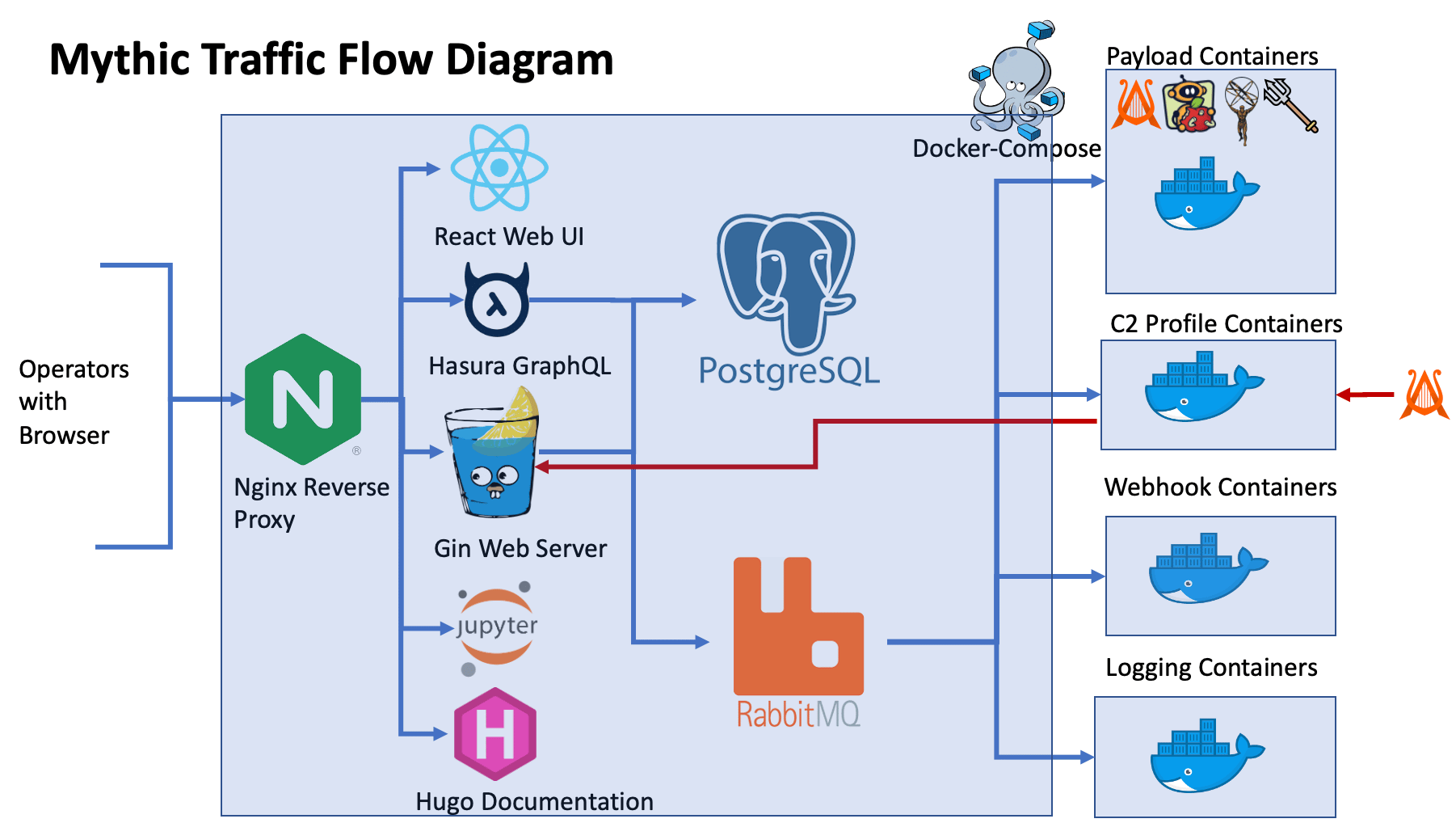
The React interface and Go server use GraphQL, subscriptions, PostgreSQL, and RabbitMQ. Payload type, C2 profile, translation, web hook, eventing, log, and chat services run in separate containers and can live on the same host or on remote container hosts.
A helpful view of the current state of the C2 Profiles and Agents for Mythic can be found here:
 ## What is new in 4.0?
Mythic 4.0 adds scoped opaque API tokens, operation chat and AI chat containers, operator aliases, task references, richer build and C2 parameters, conditional wrapper compatibility, interactive eventing approvals, resumable byte-offset file transfers, an interactive text editor, richer credentials, managed C2-hosted files, and agent-initiated RPC.
Migrate authentication, API actions, container libraries, wrappers, and integrations.
Use standard operation chat or streamed AI-backed conversations.
Resolve credentials and callback graph links safely during tasking.
Adopt JSONString parameters, build metadata, and wrapper requirements.
## Why use Mythic?
Mythic tracks the payload, build parameters, C2 configuration, loaded command versions, issuing operator, task references, artifacts, credentials, files, comments, and responses that form an operation. That context makes questions such as “which payload created this callback?”, “who issued this task?”, and “what changed on this host?” answerable from the same interface.
Commands can map to [MITRE ATT\&CK](https://attack.mitre.org) techniques. Mythic carries those mappings into tasks and exposes them in matrix and [ATT\&CK Navigator](https://github.com/mitre-attack/attack-navigator) views. Operators can also search tasking, output, comments, files, credentials, and chat while working collaboratively.
## Resources and contributing
* Browse the [Mythic source code](https://github.com/its-a-feature/Mythic).
* Review the [community payload type and C2 profile overview](https://mythicmeta.github.io/overview/).
* Join the `#mythic` channel in the [BloodHound Slack](https://slack.specterops.io).
* Report documentation issues or contribute changes through the MythicMeta repositories.
## What is new in 4.0?
Mythic 4.0 adds scoped opaque API tokens, operation chat and AI chat containers, operator aliases, task references, richer build and C2 parameters, conditional wrapper compatibility, interactive eventing approvals, resumable byte-offset file transfers, an interactive text editor, richer credentials, managed C2-hosted files, and agent-initiated RPC.
Migrate authentication, API actions, container libraries, wrappers, and integrations.
Use standard operation chat or streamed AI-backed conversations.
Resolve credentials and callback graph links safely during tasking.
Adopt JSONString parameters, build metadata, and wrapper requirements.
## Why use Mythic?
Mythic tracks the payload, build parameters, C2 configuration, loaded command versions, issuing operator, task references, artifacts, credentials, files, comments, and responses that form an operation. That context makes questions such as “which payload created this callback?”, “who issued this task?”, and “what changed on this host?” answerable from the same interface.
Commands can map to [MITRE ATT\&CK](https://attack.mitre.org) techniques. Mythic carries those mappings into tasks and exposes them in matrix and [ATT\&CK Navigator](https://github.com/mitre-attack/attack-navigator) views. Operators can also search tasking, output, comments, files, credentials, and chat while working collaboratively.
## Resources and contributing
* Browse the [Mythic source code](https://github.com/its-a-feature/Mythic).
* Review the [community payload type and C2 profile overview](https://mythicmeta.github.io/overview/).
* Join the `#mythic` channel in the [BloodHound Slack](https://slack.specterops.io).
* Report documentation issues or contribute changes through the MythicMeta repositories.